
Semiconductor cleanrooms require strict control of airborne particles, airflow pattern, temperature stability, humidity, electrostatic discharge and maintenance discipline. Even very small contamination events can affect yield, so the cleanroom must be designed as a complete system rather than a simple enclosure with filters.
For buyers, the main planning questions are process sensitivity, target ISO class, tool layout, heat load, ceiling coverage, ESD requirements and future expansion. The best solution should support production stability and maintenance access without creating unnecessary complexity.
Particle and ESD Priorities
Particle control is central because particles can interfere with sensitive surfaces, optics or micro-scale features. Airflow should remove particles from critical zones and avoid turbulence that returns contamination to the process. The cleanroom class should match the process step and tool requirement.
ESD control is also important because static discharge can damage components or attract particles. Flooring, footwear, workstations, grounding and humidity control should be reviewed together. ESD flooring alone is not enough if the rest of the control program is missing.
Cleanroom Class and Airflow Strategy
Different semiconductor processes may require different cleanliness levels. Some areas need very high ceiling coverage and unidirectional airflow, while support rooms may use less demanding conditions. Overclassifying every space can increase cost without improving yield.
The airflow strategy should consider process tools, heat load, maintenance routes and return air paths. Tool exhaust, service chases and raised floors may influence room performance. The design should prevent equipment layout from blocking clean airflow to critical areas.
FFU and ULPA Filter Use
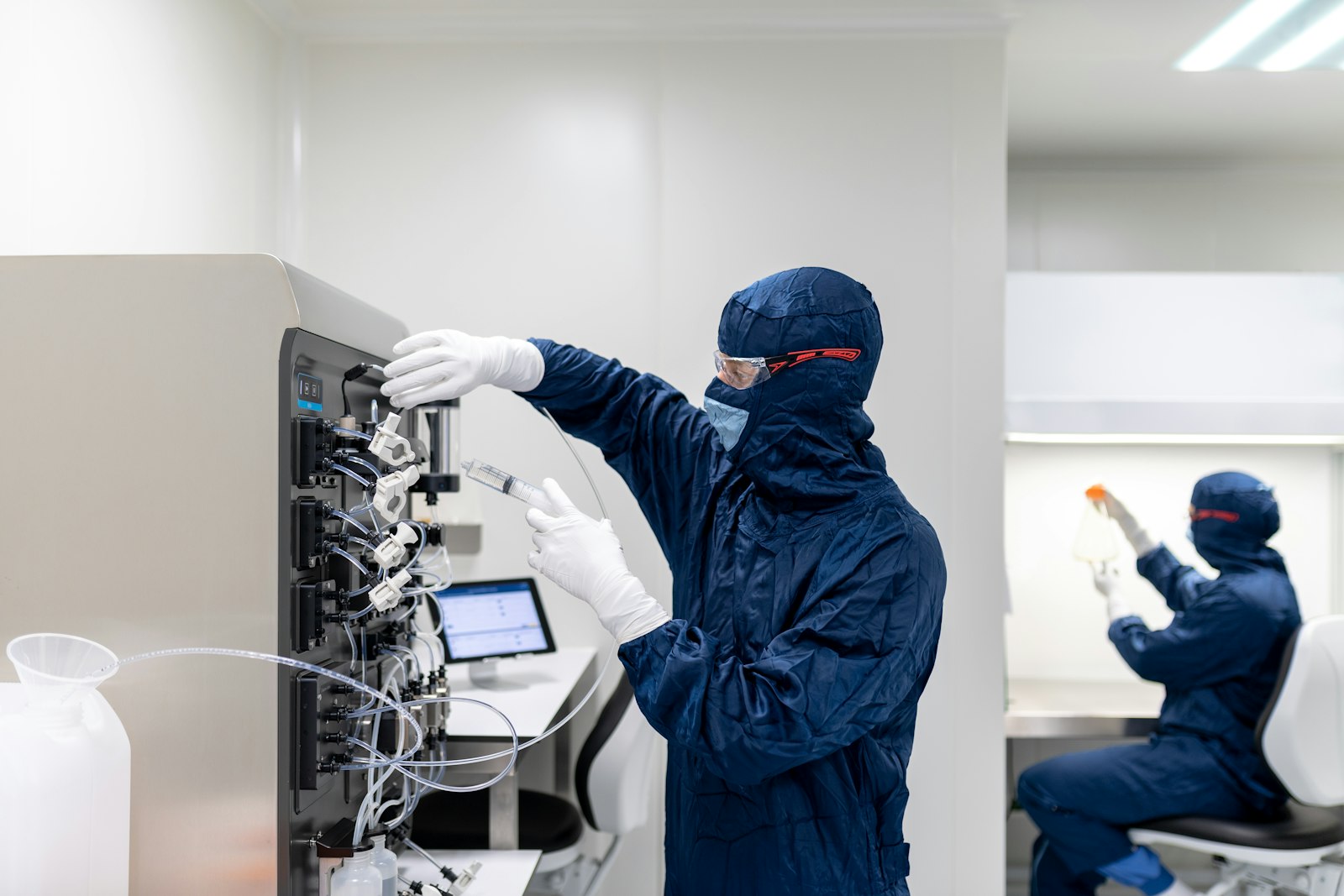
FFU systems are often used where flexible ceiling coverage and localized high-efficiency filtration are needed. They allow the design team to adjust clean air coverage by zone and can support future layout changes. However, many FFUs also mean many motors, filters and control points.
ULPA filters may be selected for very fine particle control, but the higher efficiency must be matched with fan capacity and maintenance planning. Buyers should review filter grade, pressure drop, access method and integrity testing. A high-efficiency filter that cannot be maintained properly will not protect yield over time.
ESD Flooring Considerations
ESD flooring should provide suitable resistance and durability for the process area. It must also tolerate cleaning, traffic and equipment movement. The flooring specification should define resistance range, test method, grounding detail and maintenance requirements.
Flooring should be coordinated with wall systems, coving, tool bases and cable routing. Poor transitions or damaged seams can create cleaning problems and weaken ESD performance. The ESD control plan should be verified after installation, not assumed from material selection alone.
Supplier Checklist
Semiconductor cleanrooms need suppliers who understand both construction and operating risk. The proposal should explain how particles, airflow, ESD and maintenance will be controlled together.
- Confirm target class by process zone.
- Review FFU coverage, return path and heat load.
- Define ULPA or HEPA filter grade and test scope.
- Coordinate ESD flooring, grounding and verification.
Hurricane Techs Recommendation
Plan semiconductor cleanrooms around yield-sensitive zones instead of applying one specification everywhere. The room should support process tools, airflow, ESD control and future maintenance.
Hurricane Techs supports FFU systems, ULPA and HEPA filters and ESD flooring for semiconductor and precision manufacturing cleanrooms.
FAQ
What class is used for semiconductor production?
It depends on the process step. Critical zones may require stricter control than support areas.
Why is ESD flooring important?
It helps control static discharge risk when used with footwear, grounding and ESD procedures.
Are ULPA filters required?
They may be required for very fine particle control, but the process and system design should drive the decision.


