
The main difference between H13 and H14 HEPA filters is their minimum overall efficiency at the most penetrating particle size (MPPS): H13 is at least 99.95%, while H14 is at least 99.995% under the EN 1822 classification. H14 therefore allows one-tenth of the maximum overall penetration permitted for H13. However, the correct cleanroom choice also depends on airflow, pressure drop, housing seal, fan capacity, process risk and installed integrity testing.
H14 is not automatically the better project specification. A well-designed system using the required filter grade, adequate airflow and a leak-tight terminal housing can outperform a poorly balanced system fitted with a higher grade. Buyers should select H13 or H14 as part of the complete HVAC and contamination-control design rather than treating the filter label as the cleanroom class.
H13 vs H14 HEPA Filters at a Glance
| Selection pointH13 HEPAH14 HEPA | ||
| Minimum overall efficiency at MPPS | ≥99.95% | ≥99.995% |
| Maximum overall penetration | ≤0.05% | ≤0.005% |
| Typical reason to select | Required performance can be met with lower lifecycle resistance or cost | Stricter particle-risk or project specification justifies the higher efficiency |
| Pressure drop | Must be checked on the specific model and rated airflow | May be higher, but media area and construction can change the comparison |
| Factory evidence | Filter classification and test documentation | Filter classification and test documentation |
| Site acceptance | Installed integrity testing where required | Installed integrity testing where required |
The efficiency values above should be read at MPPS, not casually rewritten as “99.95% at 0.3 µm” for every filter. MPPS depends on the media and test condition. Current international classification and test requirements are covered by ISO 29463-1:2024 and related parts; many project specifications continue to use the familiar EN 1822 H13 and H14 designations.
What H13 and H14 Ratings Actually Mean
A HEPA grade describes tested filter performance under a defined procedure. It does not mean the filter captures the stated percentage of every particle size under every field condition, and it does not classify the room. Cleanroom classification under ISO 14644 is based on the concentration of airborne particles in the room, while HEPA classification concerns the filter element.
H14 has ten times lower maximum overall penetration than H13: 0.005% compared with 0.05%. That is a meaningful difference where the process risk or acceptance specification requires it. But the filter must still be correctly sized, protected, transported, installed and tested. Air bypassing the gasket or housing does not pass through the media and is not corrected by selecting a higher efficiency label.
When comparing quotations, ask the supplier to state the test standard, filter class, MPPS result, rated airflow, initial resistance, dimensions, frame and seal type, test report format and filter identification. A certificate without a traceable filter ID is difficult to use during installation, validation and replacement.
Efficiency Is Not the Same as Installed Integrity
Factory efficiency and site integrity answer different questions. Factory testing establishes the filter element’s classification and performance when manufactured. HEPA filter integrity testing checks whether the installed filter, frame, gasket or gel seal and housing have unacceptable local leakage after transport and installation.
| CheckWhat it verifiesWhen it matters | ||
| Factory classification test | Filter efficiency and leakage performance under the applicable manufacturing test method | Procurement and traceability |
| Incoming inspection | Packing condition, dimensions, frame, seal and visible transport damage | Before storage and installation |
| Installed integrity test | Media, frame, seal, housing and perimeter leakage in the installed condition | Commissioning, qualification and risk-based retesting |
| Room classification | Airborne particle concentration under the agreed room state | Cleanroom acceptance and requalification |
A project can therefore fail even when every H14 filter has a factory report. Poor gasket compression, a damaged gel seal, an out-of-square housing or careless handling can create a bypass path. Conversely, moving from H13 to H14 may add cost and resistance without solving a room failure caused by insufficient airflow, dead zones, uncontrolled doors or operator activity.
Airflow Resistance and Fan Capacity
Higher efficiency often requires a different media design, but buyers should not assume every H14 filter has more resistance than every H13 filter. Pleat depth, media area, separator design, face velocity, frame depth and manufacturer construction all affect pressure drop. Compare actual model data at the intended operating airflow.
Initial resistance affects commissioning airflow and fan duty. Final or recommended replacement resistance affects lifecycle capacity. The AHU or fan filter unit must have enough available static pressure to deliver the required air volume as the filter loads, while the controls still maintain room balance and pressure cascade.
For a simple fan-power comparison, a higher system pressure requirement generally increases energy demand at the same airflow and efficiency. The total effect depends on fan selection, motor efficiency, control strategy and operating hours. Procurement should therefore compare filter purchase price together with fan energy, prefilter strategy, service life, replacement labor and production interruption.
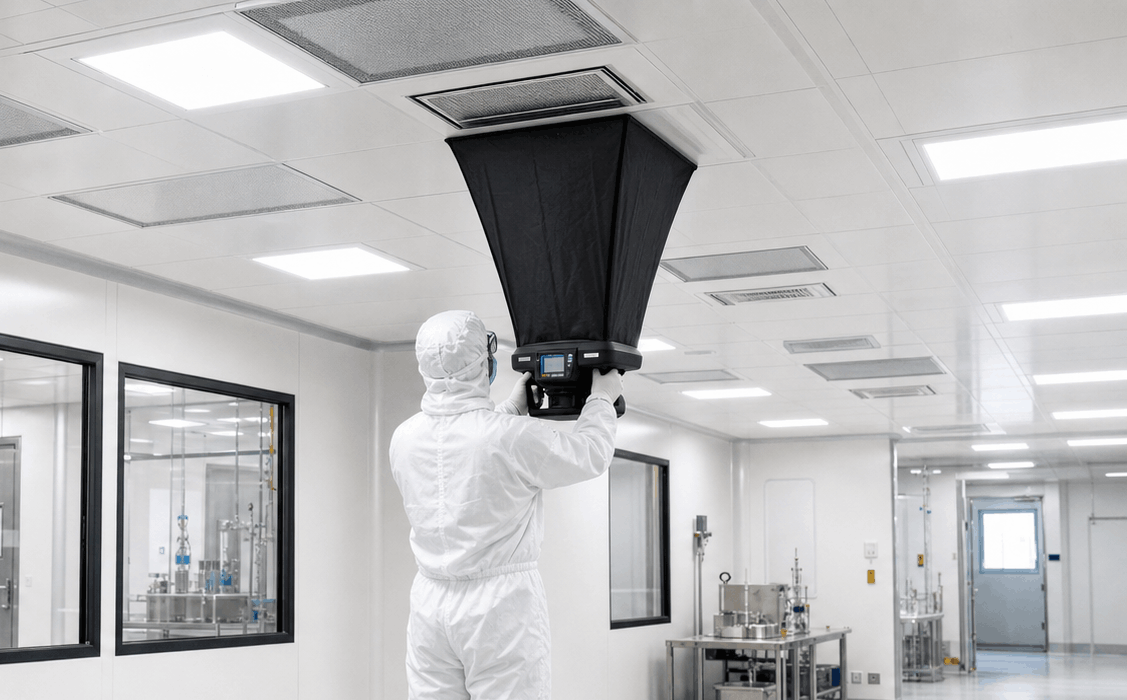
Which Grade Fits Different Cleanroom Applications?
The target ISO class alone does not prescribe H13 or H14. The correct grade should be justified by process risk, local protection, regulatory expectation, customer specification and the total airflow design. Two ISO 7 rooms can use different filtration strategies because one is a low-risk packaging background and the other supports an exposed pharmaceutical process.
- General controlled production and support zones: H13 may be suitable when the engineering assessment shows that the room class and process controls can be maintained with that grade.
- Critical terminal supply or stronger product protection: H14 is commonly considered when lower penetration, individual scan testing or a stricter owner specification is required.
- Local ISO 5 protection: The terminal filter choice must be evaluated with unidirectional airflow, velocity uniformity, coverage, intervention risk and installed integrity—not by grade alone.
- Containment exhaust: Filter grade, safe-change housing, redundancy, decontamination and disposal can be more important than a simple H13/H14 comparison.
- High-temperature or chemical exposure: Standard cleanroom media and sealants may not be suitable; select a construction qualified for the real operating condition.
For pharmaceutical facilities, the contamination-control strategy and qualification plan should identify why a grade is selected at each location. For electronics and precision manufacturing, yield risk and the critical particle size may drive the decision. Medical device and laboratory projects should connect the choice to the product, process and internal quality requirements.
Frame, Seal and Housing Options
Filter grade is only one line in the specification. The frame must match the terminal module or FFU, and dimensional tolerances must support correct sealing. Common arrangements include gasket seals and gel seals; each requires the matching housing design, installation method and replacement procedure.
A gasketed filter needs appropriate compression around the complete perimeter. Too little compression can leak, while uneven or excessive clamping can distort the frame. A gel-seal filter relies on the housing knife edge entering sound gel continuously. Damage, contamination or incorrect seating can create a bypass path even when the media is undamaged.
Review service access before ordering. Technicians need room to inspect, install and remove the filter without bending the frame or touching the media. Where installed scanning is required, the housing and surrounding ceiling layout must also permit full access to the downstream face and perimeter.
Procurement and Shipping Risks
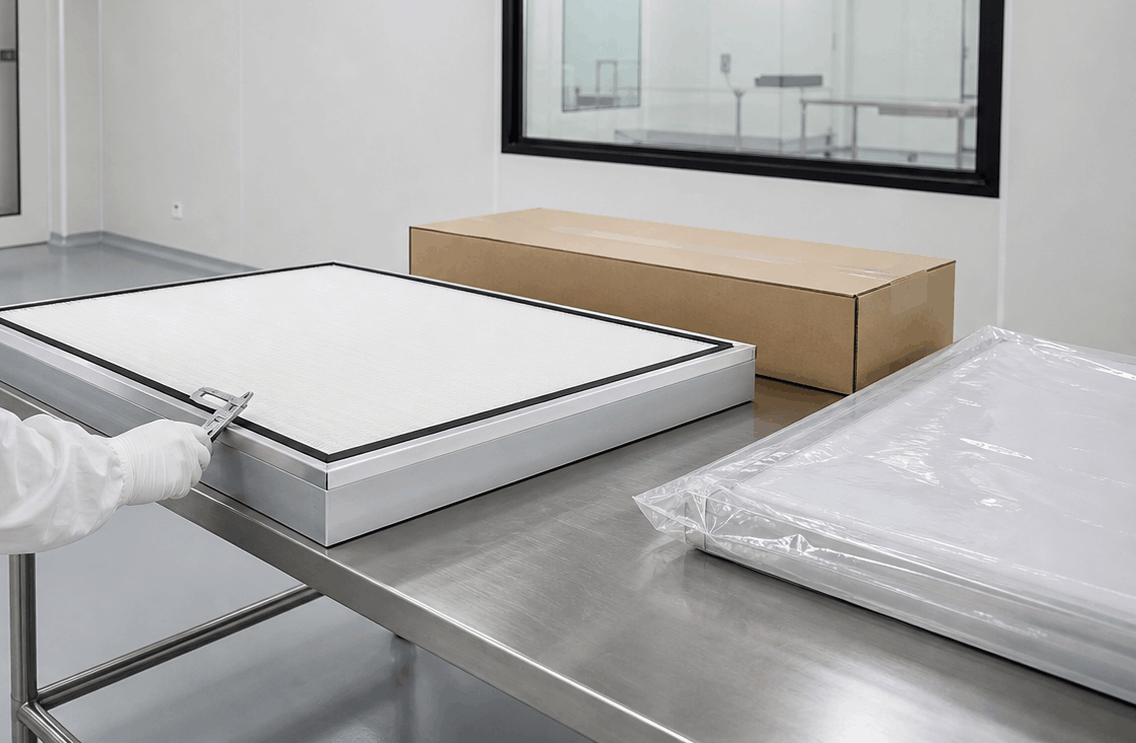
High-efficiency media is delicate. Filters should be packed to control impact, vibration, moisture and incorrect orientation. Overseas buyers should agree on crate construction, handling labels, inspection on arrival, storage limits and the process for reporting concealed damage.
Spare filters should be ordered against a controlled schedule, not only by nominal dimensions. Confirm the filter ID, room location, exact size, frame material, seal side, airflow direction, grade, rated flow and report requirement. A “standard H14” replacement can still fail to fit the original housing or deliver the design airflow.
H13 vs H14 Selection Matrix
| Decision questionEvidence to reviewSelection implication | ||
| What contamination risk is being controlled? | Product exposure, critical particle size, hazard and quality impact | Defines whether lower penetration adds meaningful protection |
| What does the governing specification require? | URS, regulation, customer standard and validation plan | A mandatory H14 requirement should be stated explicitly |
| Can the fan deliver design airflow? | Filter resistance curve, system static pressure and fan reserve | Prevents loss of ACH, velocity or pressure cascade |
| Can the installation remain leak-tight? | Frame, seal, housing, tolerances and scan access | Determines installed performance beyond media efficiency |
| What documentation is required? | Individual report, batch record, filter ID and site test | Supports handover, audits and replacement traceability |
| What is the lifecycle cost? | Purchase price, energy, prefilters, service life and downtime | Avoids choosing only on unit price or nominal grade |
Recommended RFQ Specification
A useful HEPA filter request should provide enough information for suppliers to quote comparable products:
- H13 or H14 classification and applicable test standard.
- Exact face size, depth, airflow direction and dimensional tolerance.
- Rated airflow plus maximum acceptable initial resistance at that flow.
- Frame material and construction.
- Gasket or gel-seal arrangement, seal location and mating housing details.
- Operating temperature, humidity and chemical exposure.
- Individual test report, filter ID and labeling requirements.
- Packing, export crate, storage and spare-filter quantity.
- Installed integrity-test and validation responsibilities.
Hurricane Techs supplies HEPA and ULPA filters, FFUs and cleanroom validation support. Providing the full operating point and housing details allows filter selection to be tied to room airflow and acceptance testing rather than only to a grade label.
FAQ
Is H14 better than H13?
H14 has higher minimum overall efficiency and lower permitted penetration at MPPS. It is better only when that performance is required and the HVAC, housing, installation and testing can support it.
What is the efficiency of H13 and H14 HEPA filters?
Under the EN 1822 classification, H13 has at least 99.95% overall efficiency at MPPS and H14 has at least 99.995%.
Does an ISO 7 cleanroom require H14 filters?
ISO 14644-1 does not prescribe one HEPA grade for every ISO 7 room. The filter grade must be selected with the process risk, airflow design, owner requirements and validation plan.
Does H14 always have a higher pressure drop?
Not necessarily. Compare specific product data at the same airflow because media area, pleat design, frame depth and construction affect resistance. The selected fan must support both initial and lifecycle pressure requirements.
Can an H13 filter be replaced with H14?
Only after confirming dimensions, seal, housing, fan capacity, airflow balance and validation impact. A physically fitting H14 filter can still reduce airflow or disturb pressure control if the system lacks reserve capacity.
Do H13 and H14 filters need site integrity testing?
Where the project or quality system requires installed integrity testing, both grades should be tested as installed assemblies. A factory certificate does not cover the final housing and seal.


